
Engagement Feature Articles
Daiwa House Industry - Anticipating Social Change and Shaping the Future: The Growth Strategy of a Value Co-Creation Group for People, Communities, and Lifestyles
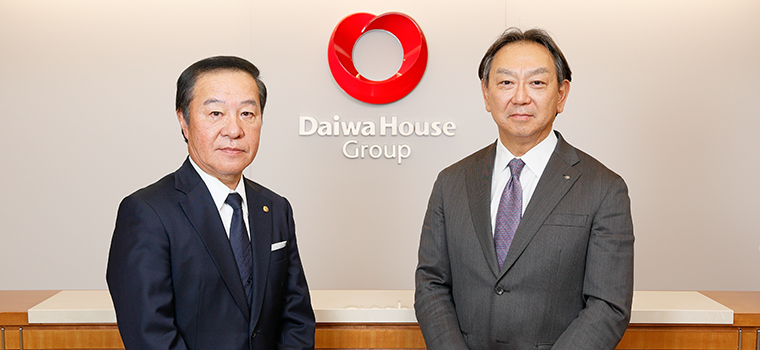
Right: Hiroyasu Koike, President and CEO, Nomura Asset Management Co., Ltd.
While housing remains its foundation, Daiwa House Industry has built sustained growth by expanding into non-residential sectors such as logistics facilities and data centers, as well as overseas operations and the existing-home market.
How is the company responding to social change and new societal needs while preparing for the future? Mr. Hirotsugu Otomo, President and Representative Director of Daiwa House Industry, joins Hiroyasu Koike of Nomura Asset Management to discuss the company's growth strategy and future outlook.
A "Three-Pronged" Business Model Guided by the Company's Founding DNA
Koike I had the opportunity to speak with Chairman Yoshii about three years ago. Since then, the company has steadily put that strategy into practice and delivered very strong earnings growth. The facilities development business in particular has been especially impressive, with gains on property sales making a significant contribution to profits. Looking back on your track record in real estate development investment and the results you are seeing today, could you share what has driven those investment returns to bear fruit?
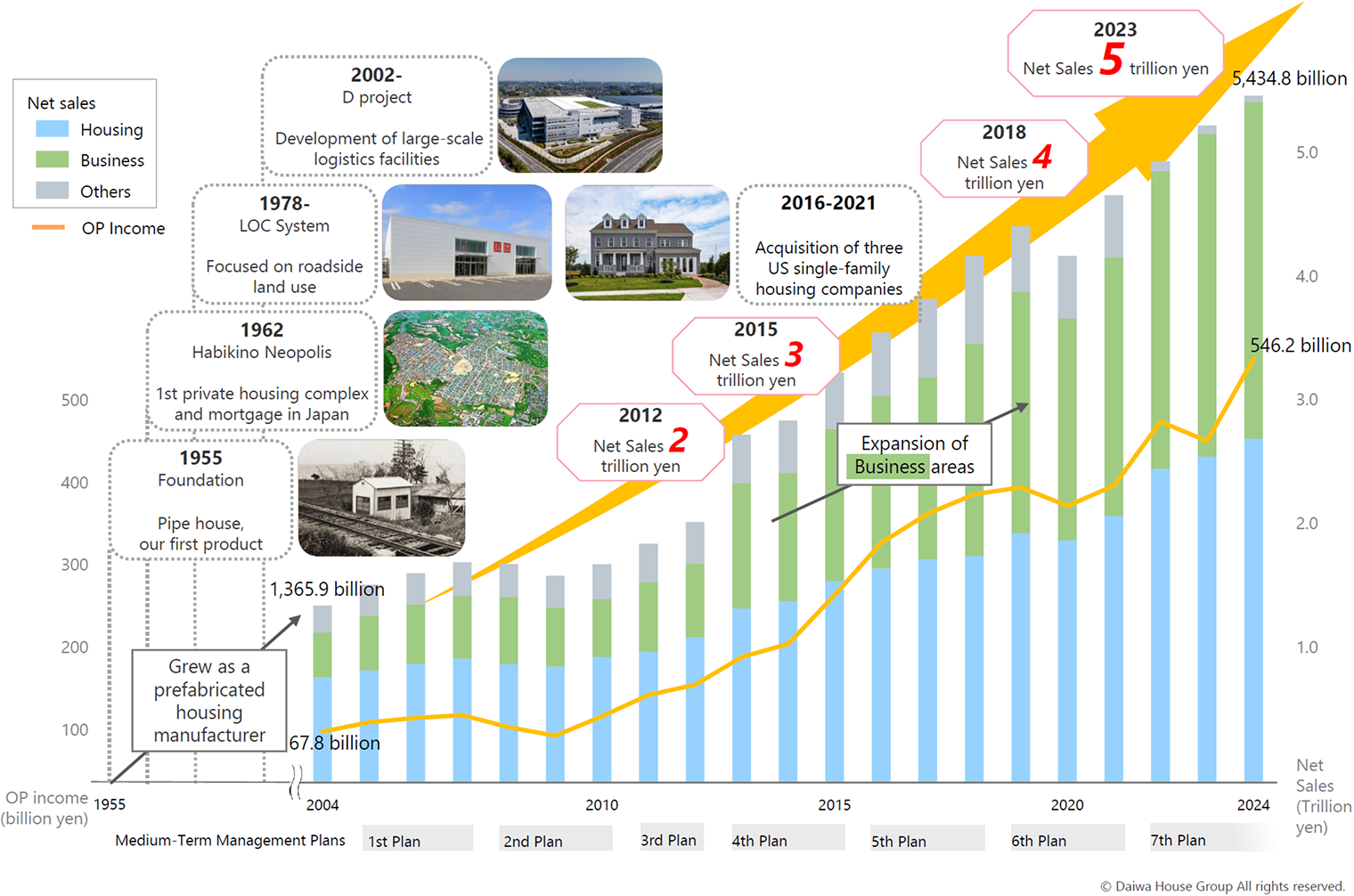
Otomo Our company was founded on the philosophy of "industrialization of construction" through prefabricated building methods, and during Japan's high-growth era, we expanded with housing as our core business. At the same time, we have consistently broadened our business domains with a close eye on evolving social needs, and that is what has led to the business platform we have today. The launch of our commercial facilities business was one such initiative: an effort to anticipate social change and translate it into a concrete business opportunity.
Over the course of 30 to 40 years, we have steadily honed not only our construction capabilities but also our integrated development expertise, including land selection and development. By involving ourselves not just as a builder, but from the land stage, the very starting point of a project, we have built up developer know-how, including in urbanization control areas where regulatory constraints are particularly stringent. That accumulation of expertise has been a key driver behind the growth of our current business solutions segment, in other words, our B-to-B business.
Founded in 1955 with the corporate philosophy of industrialized construction
Growth by realizing a 2-axis business portfolio of housing and business field
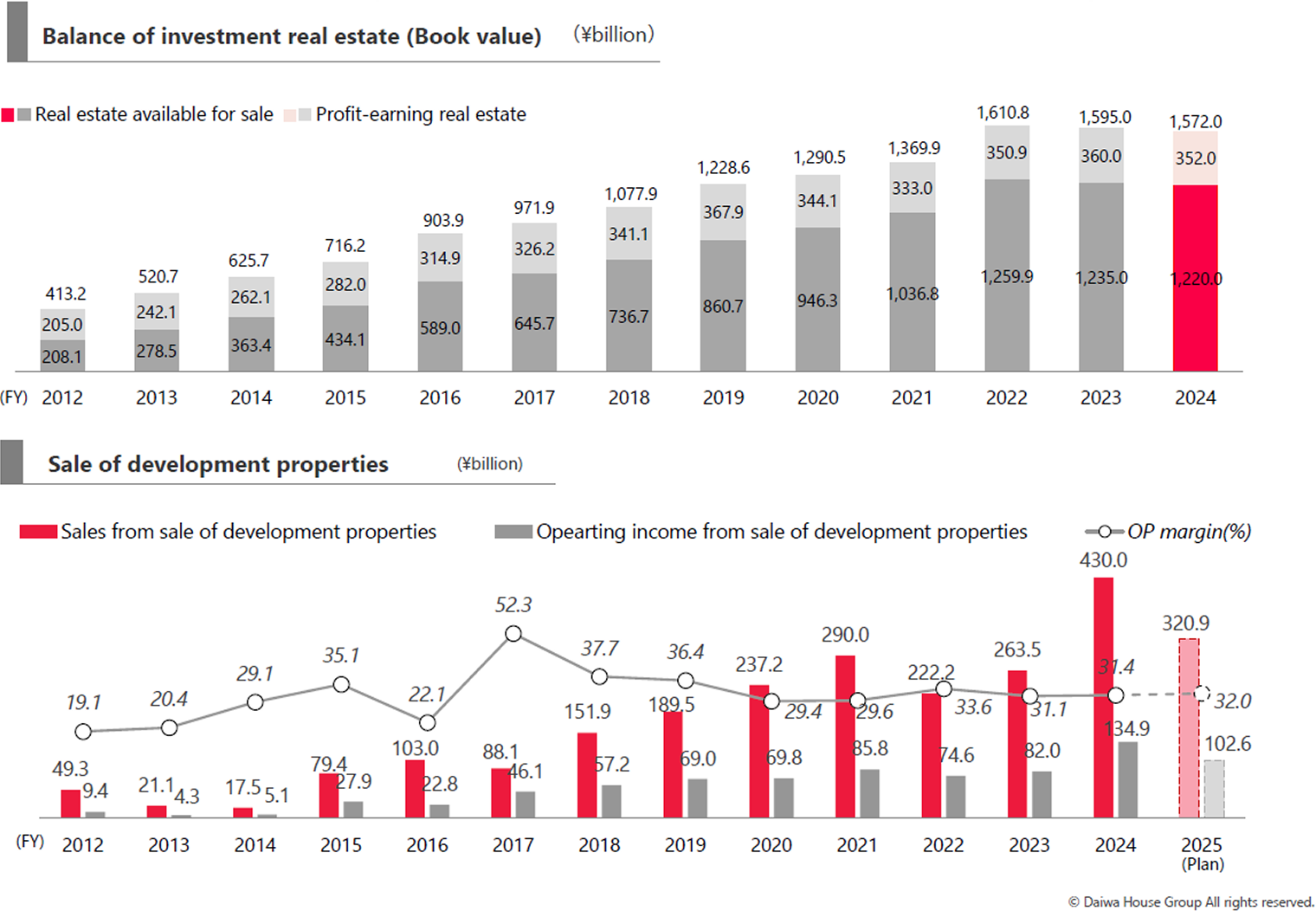
Otomo At present, the balance of investment real estate assets we have developed stands at approximately ¥1.6 trillion, and we manage these assets in an appropriate and disciplined manner, including using REITs (real estate investment trusts) for which we serve as sponsors.
This has enabled us to expand beyond a flow-based business centered on construction contracting and build up a stock-based earnings platform as well. By accurately identifying changes in social needs and legal frameworks and broadening the scope of our business accordingly, we have developed what is now often described as a "three-in-one" business model-combining the roles of housing manufacturer, general contractor, and developer.
Koike You have evolved remarkably beyond the housing image associated with your company name into areas such as logistics and real estate development.
How is the ability to identify social needs, translate them into business opportunities, and generate profits from them cultivated within the organization?
Otomo Changes in the institutional environment, including legal and regulatory reforms, can present both risks and opportunities. We have consistently sought to stay ahead of such changes and view them as business opportunities from a medium- to long-term perspective.
Underlying that approach is our philosophy as "a group that co-creates value for individuals, communities, and people's lifestyles", one that identifies the needs of society and customers and works to create value accordingly. Our efforts to transcend the boundaries of a stand-alone traditional housing business and develop businesses in a broader sense have also been a key factor in widening our business domains.
Building a Distinctively Japanese Data Center Business
Koike In the last years, you have also been placing a strong focus on the data center business. Could you share your outlook for that business?
Otomo It is said that nearly half of the world's data centers are concentrated in the United States, particularly around Washington, D.C. While Japan's data center market still has considerable room for growth, the biggest challenge in expanding the business is power generation. In addition to the amount of supply available from electric utilities and the ability to secure substation capacity, a range of other factors must also be considered, including proximity to demand centers and cooling methods.
Against this backdrop, we plan to develop the business in three formats: large-scale suburban data centers, urban data centers, and the modular data centers we recently announced. Among these, modular data centers offer the flexibility to meet the information management needs of universities, government bodies, and corporations, and we believe they have the potential to become one form of "Japanese-style data center." Our policy, therefore, is to establish data center models that are well suited to Japan's specific needs and conditions.
Koike Where do you see your company's strengths coming to the fore in the data center business? And what kind of synergies are you expecting with Sumitomo Densetsu Co., Ltd., whose full acquisition you recently announced?
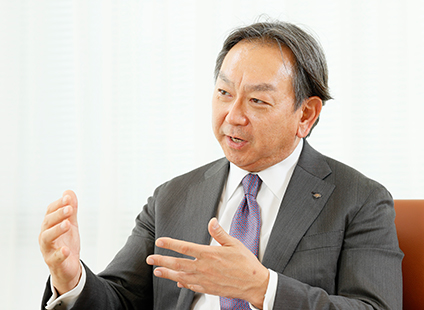
Otomo In recent years, we have seen a growing number of buildings, such as data centers and semiconductor-related plants, where internal equipment carries more weight than the building structure itself. In these fields, competitiveness comes not from housing business alone, but from the ability to address the entire related supply chain. That is why we see the synergies with Sumitomo Densetsu as extremely important.
PMI, or post-merger integration, will begin once the transaction has been fully completed. In the short term, we expect to work together in areas such as fulfilling existing orders and developing talent, while leveraging the company's technological capabilities and its strong network of partners. Over the medium-to long-term, we intend to strengthen our ability to handle higher value-added projects through collaboration from the design stage onward.
The "Livness" Business: Creating New Value from Existing Assets
Koike Housing is your founding business, but while the domestic market is shrinking, it appears that stock businesses such as renovation and the purchase-and-resale of existing homes may hold the key to future growth. Could you share your outlook for your "Livness" business going forward?
Otomo The housing market is undoubtedly facing a challenging environment when viewed against demographic trends. Even so, I see the Single-Family Houses Business as part of the social infrastructure that underpins safety and peace of mind. In Japan, where disaster risk is high and concern over energy costs is growing, there remains strong social demand for high-quality housing that offers both disaster resilience and energy efficiency.
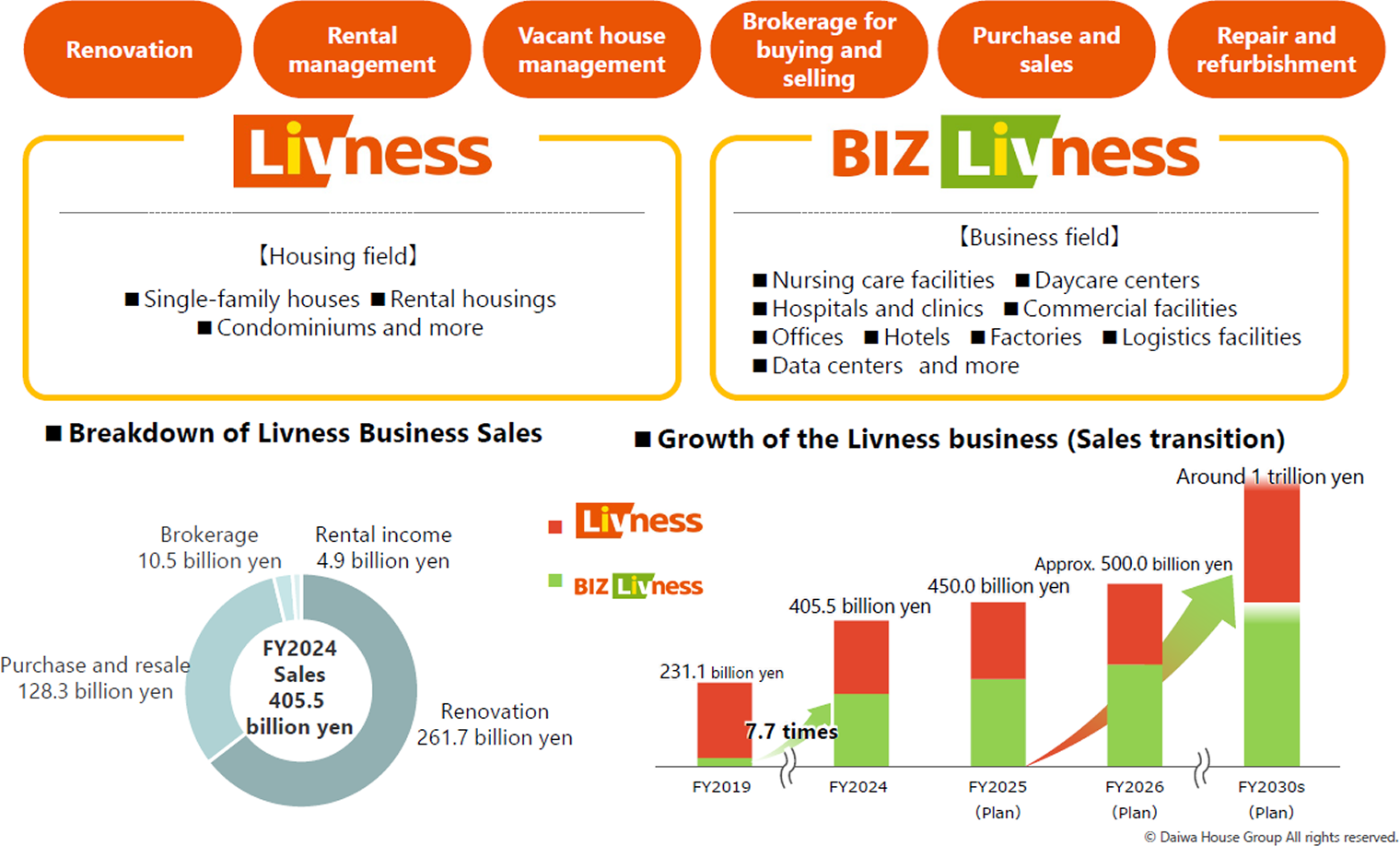
Against that backdrop, the "Livness" business is about continuing to stay close to customers as their lifestyles evolve, starting with the approximately 660,000 homes we have supplied over the years. Through renovation and the purchase-and-resale of existing homes, we refurbish properties to meet today's standards for equipment and environmental performance, enabling them to be used for many years to come while sustaining both the value of the home and our relationship with the customer. In that sense, this is not only a stock business that keeps real estate in circulation, but also a business that allows us to maintain long-term relationships with each individual customer.
The "Livness" business is set to achieve its fiscal 2026 sales target of ¥400 billion two years ahead of schedule. We are projecting ¥450 billion this fiscal year and ¥500 billion next fiscal year. Over the longer term, we believe it has the potential to grow into a ¥1 trillion business.
Koike I understand that the "Livness" business is expanding not only in housing, but also in the non-residential sector.
Otomo Against a backdrop of rising construction costs and growing demand for the effective use of existing assets, "BIZ Livness"-our business of acquiring, refurbishing, and strategically reutilizing existing logistics facilities, factories, and other non-residential assets-is also growing steadily. We are seeing an increase in large-scale projects as well, and over the longer term, we expect non-residential "BIZ Livness" to account for roughly 60% of our ¥1 trillion sales target for the broader "Livness" business.
At present, the business is centered mainly on buildings originally developed by our company, but if there is demand from customers, we would like to expand our services to include properties built by other companies as well.
To address issues such as regional revitalization, aging facilities, and vacant houses within Japan, we are working across the country to revitalize housing, social infrastructure, and urban development
Global Expansion and M&A Centered on People
Koike Daiwa House Industry also appears to have been highly successful in overseas M&A. Could you share the criteria you place particular importance on when selecting acquisition targets, and whether there are any conditions on which you are unwilling to compromise?
Otomo In M&A, we do not focus solely on short-term profitability. What matters to us is the perspective rooted in our founder's spirit: we do not pursue a business simply because it is profitable, but because it serves society. For that reason, in addition to earnings potential, we place great importance on whether a company's way of thinking and values can be shared with us and above all, on what kind of philosophy its management holds.
This is especially true overseas, where culture and business practices often differ significantly. We believe that understanding not only how the business operates, but also the background and mindset behind its management, is essential to creating long-term value.
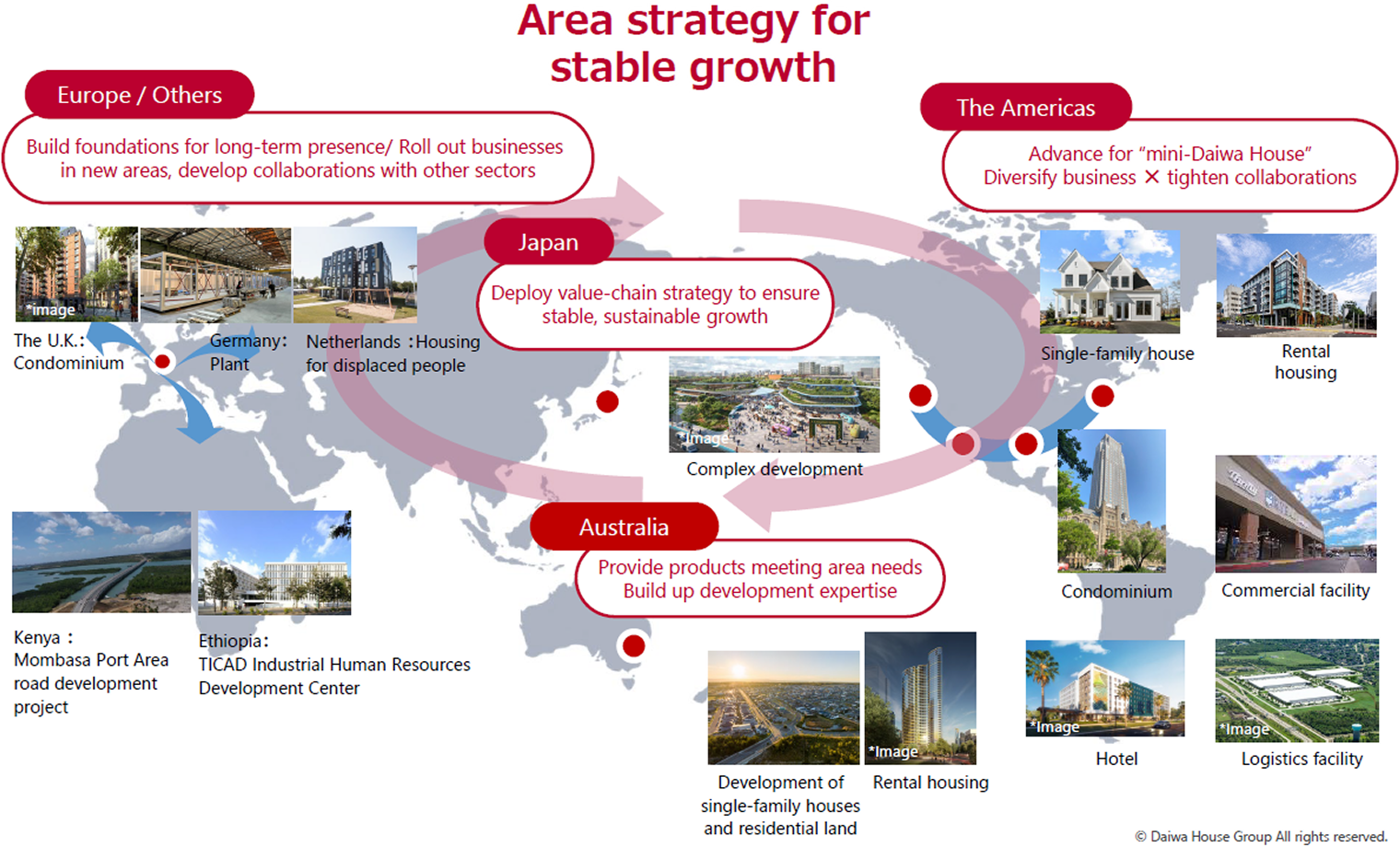
Koike How do you view the broader blueprint for your U.S. housing business, and what are your thoughts on overseas strategy beyond the United States?
Otomo In the U.S., our strategy is built on the understanding that housing is a highly regional market. We bring companies into the group that share our values, use them as regional anchors, and then expand our business footprint outward in an amoeba-like fashion while staying rooted in local communities. We respect the autonomy of our local subsidiaries, while the parent company takes the lead in establishing group-wide management structures and governance.
Outside the United States, we will continue to build on and develop the businesses we have established in ASEAN countries and Australia. At the same time, we see Europe as an increasingly important growth region going forward, and we are also paying close attention to Central and Eastern Europe, with an eye on future reconstruction demand. We believe the technologies and know-how we have developed in areas such as prefabricated construction, particularly through disaster response and reconstruction support, have applications in many parts of the world.
Achieve stable growth through expansion of business in the Americas and expansion of other areas
Organizational Reform and Future Investment to Drive Sustainable Growth
Koike As your business becomes increasingly diversified, you have been reshaping your organizational structure, including the shift to a two-headquarters system. What impact has that had, and how do you assess the results so far?
Otomo Our organizational reform is still very much a work in progress, but it is aimed at two broad objectives.
The first is to optimize our organizational functions, including allocating personnel to growth areas. While responding to changes in the business environment, we want to broaden the scope in which each employee can contribute in ways that support the company's growth.
The second is to clearly delineate the roles of oversight and execution, thereby further strengthening governance. Under this structure, each business headquarters is able to focus on execution on the ground, while the two-core headquarters take a bird's-eye view and assume oversight responsibility. In doing so, we are working to strike the right balance between quality and the speed of decision-making.
Koike I understand that you are also pursuing timber construction not only in housing, but in the non-residential sector as well.
Otomo Steel-frame structures remain our core strength but considering growing societal demands such as the circular economy and carbon neutrality, we believe there is significant medium- to long-term growth potential for timber and wood-based construction in the non-residential sector as well.
With that in mind, we established the "Future with Wood" Task Force to explore new possibilities in architecture by combining steel and concrete with wood. Around 35 employees joined the initiative through an internal open recruitment process.
We are already seeing progress in hybrid construction using steel frames and in the use of timber in projects such as nursery schools, senior care facilities, and cafeteria buildings at factories. The business is currently on the order of ¥14 billion, but over the longer term, we aim to grow it into a ¥300 billion business.
Continuing Our Unique Evolution as a Company Unlike Any Other
Koike I understand you are on track to achieve the targets of your Seventh Medium-Term Management Plan ahead of schedule. Looking ahead to the Eighth Medium-Term Management Plan, which begins in fiscal 2026, could you share your thinking on your business and financial strategy, taking into account changes in the operating environment?
Otomo We will begin by taking stock of the Seventh Medium-Term Management Plan carefully assessing both what we have achieved and where challenges remain. On that basis, we will map out the next step toward our long-term goal of reaching ¥10 trillion in revenue by 2055, our 100th anniversary. Expanding our overseas business, pursuing M&A, and reorganizing our domestic operations are all part of laying the groundwork for that vision.
At this stage, we are considering the Eighth Medium-Term Management Plan as a four-year plan. For a company like ours, where many projects, such as real estate development, span multiple years, we believe a four-year timeframe is well aligned with our business cycle. That said, we are operating in an era of rapid change, so it may well be necessary to review our progress around the midpoint, after about two years, and make course corrections where needed.
Koike Finally, if you have any message you would like to share with us as institutional investors, I would be glad to hear it.
Otomo Our business portfolio is sometimes discussed through the lens of a conglomerate discount. However, ours is a company that has evolved in a unique way by combining businesses in response to changes in society.
I believe there is merit not only in the "Western medicine" approach, making surgical interventions such as divestments or concentrating investment, but also in an "Eastern medicine" approach-strengthening the company's overall constitution over time. In other words, having a diverse portfolio is not simply about diversification for its own sake; it is a strategic choice designed to achieve both long-term growth and stability.
We believe this one-of-a-kind business portfolio is what defines Daiwa House and underpins our competitive strength. By continuing to respond to society's needs and evolving in our own distinctive way, we aim to deliver sustainable growth over the long term.
Koike Thank you for sharing such a powerful message.
This article is not intended as investment solicitation, nor does it constitute a recommendation to buy or sell any specific security or imply any rise or fall in price.
(Date of publication: March 23, 2026)